
Classic Or Modern Power? Choosing The Right Engine For Your Restomod Mustang


One of the biggest decisions in any restoration or hot rod build is made long before the paint color, wheel style, and upholstery are ever decided on. That decision is what kind of powerhouse will reside under the hood.
Some owners may want the raw, pure mechanical personality of an old-school V8. Where sound, throttle response, simplicity, and the Ford Performance heritage all matter more than anything. While others may want everything a modern Mustang has under the shell of a classic. Coyote power, fuel injection, refined drivability, and the kind of performance Lee Iacocca could only dream of in 1964.

But which do you choose? The right engine comes down to what you want the car to be. Do you prefer classic or modern? Raw or refined? Mechanical or electronic? NA or boosted? There's no wrong answer when it comes to choosing; it's just the direction you want to take the car.
At Restomod Mustangs, every build is shaped around that vision. Whether the goal is a mild small block for casual cruising, a supercharged big block for pure power, or a turbocharged Coyote for peak performance, the power package is designed around the owner, the car, and the desired driving experience.
The 427 Stroker: Old-School Muscle With Serious Power

For the owner who wants a Mustang that still feels deeply connected to the golden era of American performance, the 427 stroker small block Ford is hard to beat.
This engine choice keeps the car rooted in classic Mustang character. Capable of making 550hp, the 427 delivers the sound, torque, throttle response, and raw mechanical personality that many people expect when they imagine a high-end vintage Mustang. It feels muscular in a way that is different from modern engine platforms. It is less about refinement and more about attitude.
A 427 stroker gives the car a sense of occasion every time it starts. The idle has presence. The throttle response feels immediate. The torque comes in strong. Paired with something like a Tremec manual transmission, it creates a driving experience that feels analog, engaging, and unmistakably old-school.

This is the engine for the owner who wants the car to feel like a classic Mustang first, but with far more power and capability than the original platform ever offered.
The tradeoff is that an old-school performance engine will never feel exactly like a modern Coyote. It may not have the same refinement, efficiency, or factory-engineered smoothness. But for many buyers, that is the entire point. A 427 stroker Mustang does not try to hide its personality. It puts itself front and center every time you hit the gas.
The Coyote: Modern Ford Performance in a Classic Mustang Shell

For the owner who wants modern drivability, modern power delivery, and a more refined performance experience, the 460-horsepower Gen 3 5.0L Coyote is one of the strongest choices available.
The Coyote has become one of the defining engines of modern Ford performance. In a classic Mustang, it completely changes the personality of the car. Instead of leaning fully into old-school muscle, a Coyote-powered restomod blends vintage styling with modern engineering.
That means smooth power, high RPM capability, fuel-injected reliability, and a driving experience that feels more current. It is still a classic Mustang, but it behaves with the confidence and refinement of a much newer performance car.
This engine choice is perfect for the owner who wants the look of a classic Mustang but does not necessarily want the quirks that come with a traditional vintage powertrain. A Coyote-powered car can feel more polished, more predictable, and easier to live with, especially when paired with the right transmission, suspension, braking, and cooling systems.

This is the engine for the person who wants to get in, turn the key, and enjoy the car without feeling like they are giving up modern performance expectations.
A Coyote-powered 1965-66 Mustang Coupe, Fastback, Convertible, or GT500-style build gives the owner the best of both worlds: classic Mustang presence with 21st-century power underneath.
Supercharged Power: For The Driver Wanting Instant Power

For some owners, naturally aspirated power is not enough.
That is where supercharged engine combinations come into play. A supercharged Restomod Mustang is for the driver who wants instant excitement. The added power, the sound, the response, and the visual presence a blower creates under the hood all create a more aggressive personality. This type of setup can be built around different engine combinations depending on the goals of the car, but the overall idea is the same: building a 1,000-horsepower capable powertrain that adds more presence and excitement at every corner.
Supercharging works especially well for owners who want big horsepower without losing immediate response. Unlike some turbocharged setups that may feel more progressive depending on the build, a supercharged combination delivers a strong, instant connection between throttle input and acceleration.
This is where a restomod starts to move beyond classic muscle and into modern supercar territory. The car still looks like a vintage Mustang, but the performance level can be far beyond anything the original platform was designed to handle.

That is why the entire build has to be engineered around the engine. Suspension, brakes, rear end, cooling, tires, and chassis reinforcement all need to match the power level.
Big power is only impressive when the rest of the car can use it. A supercharged Warhorse can.
Turbocharged Power: Maximum Performance Potential
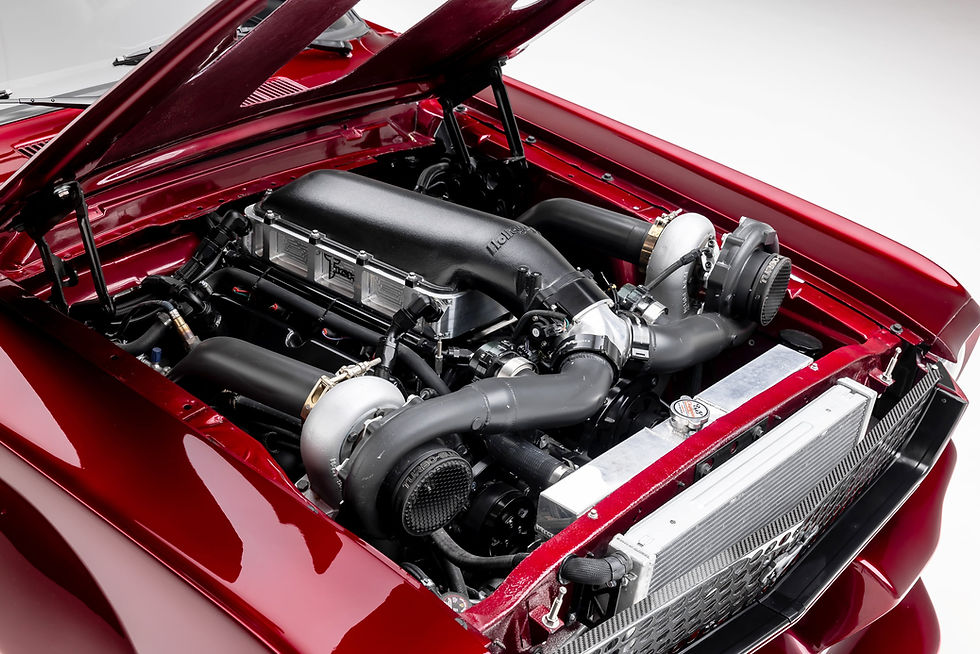
For the owner chasing serious horsepower, turbocharged combinations open the door to some of the most extreme Restomod Mustang builds.
When properly built, a turbocharged Mustang can deliver well over 1,000-horsepower while still offering a level of control and tuning flexibility that makes it extremely appealing for high-end custom builds.
This is not necessarily the choice for the person who wants the most traditional classic Mustang feel. It is the choice for someone who wants to push the platform into something much more modern, aggressive, and into the racing culture.

This is where the Warhorse Mustang ceases being simply a restomod and becomes something closer to a hand-built performance weapon. Ready for any mountain road, track day, or national show.
For A Little More Uniqueness And Power: The Boss 429 Inspired Big Block Ford

For the owner who wants maximum old-school presence like in our Boss 429 Mustangs, the 502ci hemi-head big block Ford is the engine that turns a Restomod Mustang into something far more commanding.
Inspired by the legendary Boss 429 era, this powerplant takes the idea of big-block Mustang performance and brings it into the modern restomod world. With over 750 horsepower on tap, it delivers the kind of force, sound, and road presence that made Ford’s big-block cars so unforgettable, while blowing the doors off the original 429 in terms of usable performance.
Paired with either a Tremec 5-speed manual or an automatic transmission, the 502ci big block gives the car a completely different personality than a small block or Coyote-powered build. It feels bigger, more violent, and more authoritative. Every start-up, throttle input, and gear change reminds you that this is not just a classic Mustang with more power — it is a modern interpretation of one of Ford’s most iconic muscle car legends.

The 502ci hemi-head big block Ford is not the subtle choice. It is for the owner who wants their Mustang to feel dominant, dramatic, and unmistakably rooted in legendary Ford history.
Old-School Power vs. Modern Power

The biggest difference between a classic engine and a modern engine is not just horsepower. It’s Feel. An old-school small-block Ford delivers a more mechanical experience. It sounds raw, feels direct, and has a traditional muscle car attitude that fits the image many people have when they think of a classic Mustang. It is emotional, visceral, and full of character. Modern Coyote power is different. It is smoother, more refined, more efficient, and more technically advanced. It gives the car a more current driving experience while still allowing the classic Mustang body to remain the visual centerpiece.
One is not better than the other. They simply serve different owners. Choose old-school power if you want the car to feel more traditional, more analog, and more connected to the original Mustang era.
Choose modern Coyote power if you want the car to feel more refined, more dependable, and more in line with modern performance expectations.

Choose supercharged or turbocharged power if you want the car to become something far more aggressive and performance-focused. The best engine is not always the one with the highest number on the spec sheet.

It is the one that matches the way you want to drive.


This was such an insightful read, and I truly appreciate you sharing your expertise on this topic! You've really made me reconsider my own perceptions of "classic modern." It's a concept I hadn't fully grasped until now, and it’s fascinating to think about how it’s evolving. I'm particularly curious about where you see this classic modern trend heading in the near future. Will it become even more niche, or do you anticipate a broader adoption https://www.beyondblue.org.au/ Beyond the future trajectory, your discussion about the kind of content we save and revisit really resonated. I find myself bookmarking articles and videos that offer practical how-tos and deep dives into specific technical aspects, which aligns with the more tangible elements of classic…
I found this blog post quite informative learn more here The way you've broken down the topic makes it accessible for everyone https://en.wikipedia.org/wiki/Digital_marketing Thanks for sharing your knowledge!